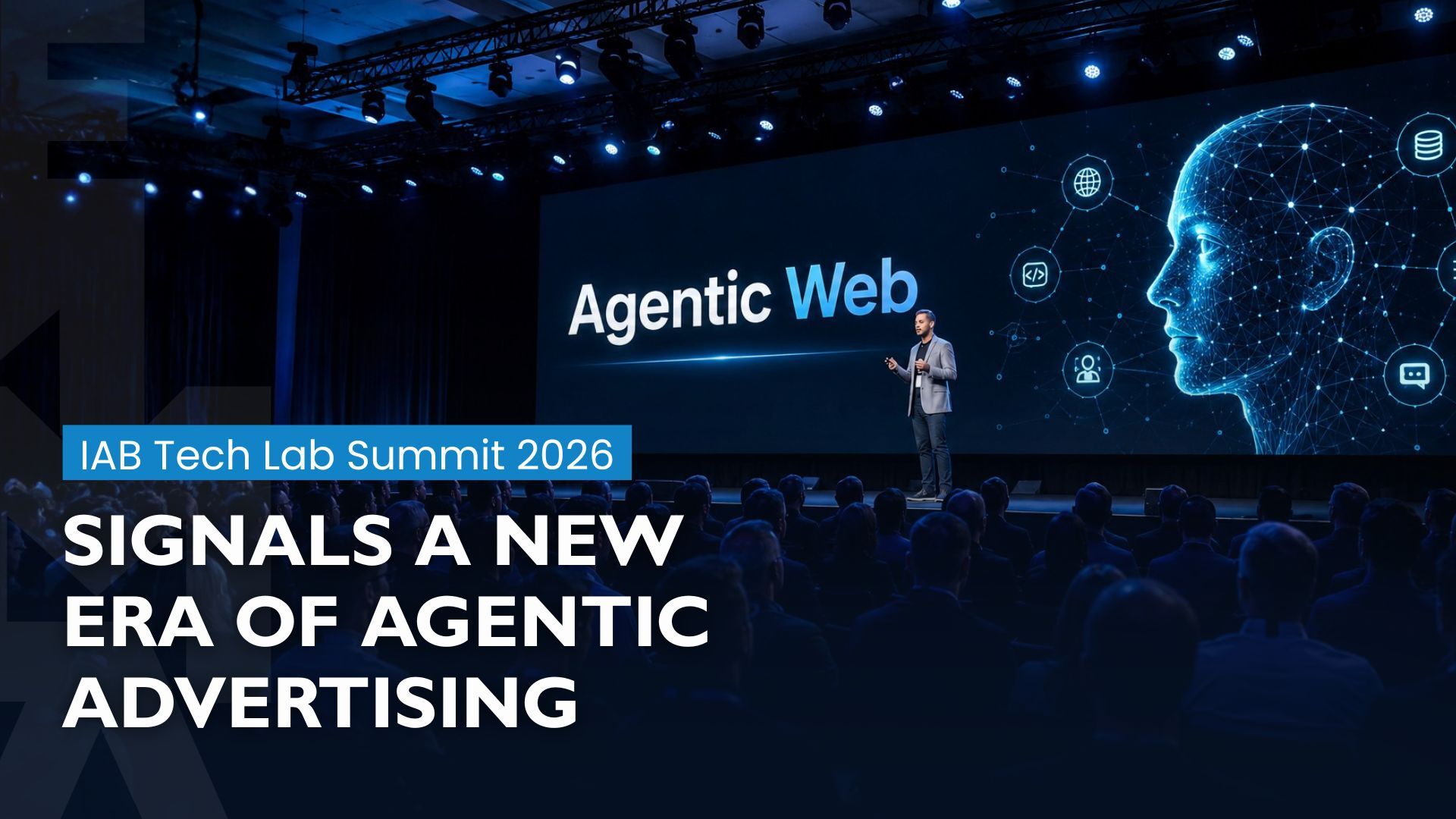


The advertising industry has spent years building automation into media buying, audience targeting, and campaign optimization. But the conversations emerging from the IAB Tech Lab Summit 2026 suggest the industry is now preparing for something much bigger than autonomous systems that can interpret, decide, and act in real time.
This year’s summit theme, “Welcome to the Agentic Web,” reflects a growing shift toward AI-driven ecosystems where machine-to-machine interactions are becoming central to how content, media, and advertising operate. The focus is no longer just on automation. It is moving toward the infrastructure powering the next phase of digital advertising.
What the Agentic Web Means for Advertising
The idea behind the Agentic Web is simple: AI systems are evolving from assistants into active participants within digital environments. A good example of this shift can already be seen in everyday consumer behavior. Instead of manually searching across multiple websites for flights, restaurants, products, or content recommendations, people are increasingly relying on AI-powered assistants to simplify decisions, compare options, summarize information, and even take actions on their behalf.
As conversational AI and intelligent agents become more integrated into online experiences, visibility will increasingly depend on how AI systems interpret context, relevance, and intent in real time. Instead of relying only on clicks, searches, or direct interactions, brands will need to focus on how they are surfaced and understood within AI-driven environments.
This is why conversations around AI, trust, identity, and contextual intelligence are becoming increasingly important across the industry.
Advertising Is Moving Toward Real-Time Autonomous Systems
Programmatic advertising introduced automation into media buying, but most systems still operate within human-defined workflows. Agentic advertising moves beyond that model toward systems capable of making dynamic decisions in real time. This includes campaign optimization, creative delivery, audience activation, and media allocation across channels. As AI systems become more adaptive, advertising starts functioning as a continuously evolving ecosystem rather than a fixed campaign structure.
At the same time, this shift introduces technical challenges. Real-time advertising environments operate at machine speed, where milliseconds determine outcomes. Traditional AI architectures relying on distant cloud-based processing can struggle with the latency required for live auctions and programmatic execution.
This challenge was recently explored by Gulab Patil, Founder & CEO – Lemma, in his article published by IAB Tech Lab, which discussed how “Agentic Sidecar” architecture could help enable faster, interoperable, and real-time AI execution within advertising systems.
Why Context and Open Standards Matter
One of the strongest themes emerging from the summit is the growing role of context in AI-driven advertising ecosystems.
In an agentic environment, context becomes more than a targeting layer. It becomes the foundation through which AI systems interpret meaning, relevance, and intent. As AI increasingly mediates how content and advertising are surfaced, brands will need to focus not only on visibility, but also on how they are understood within these systems.
At the same time, the industry is recognizing the importance of open standards and transparent frameworks. As advertising becomes more autonomous, interoperability between platforms, AI agents, identity systems, and media environments becomes critical, especially across omnichannel ecosystems such as DOOH, CTV, mobile, and retail media.
The Industry Is Entering an Infrastructure-Led Era
The conversations surrounding the IAB Tech Lab Summit 2026 make one thing clear: the next evolution of advertising will not simply be defined by better automation tools, but by the infrastructure enabling intelligent, interoperable, and real-time ecosystems.
As AI-driven advertising continues to evolve, the focus is shifting toward contextual intelligence, adaptive identity frameworks, machine-speed execution, and transparent systems capable of supporting autonomous decision-making at scale. The industry is moving beyond isolated campaigns toward connected ecosystems where media, data, and AI can work together seamlessly across channels.
At Lemma, these shifts continue to shape how we think about the future of advertising innovation and intelligent media infrastructure. This vision is reflected in the recent launch of Lemma Integral, our AI-powered platform designed to connect Out-of-Home advertising with measurable digital outcomes across omnichannel environments. As the industry moves toward more adaptive and connected ecosystems, the opportunity lies in building technologies that are not only automated but also interoperable, responsive, and built for the next generation of AI-driven advertising experiences.